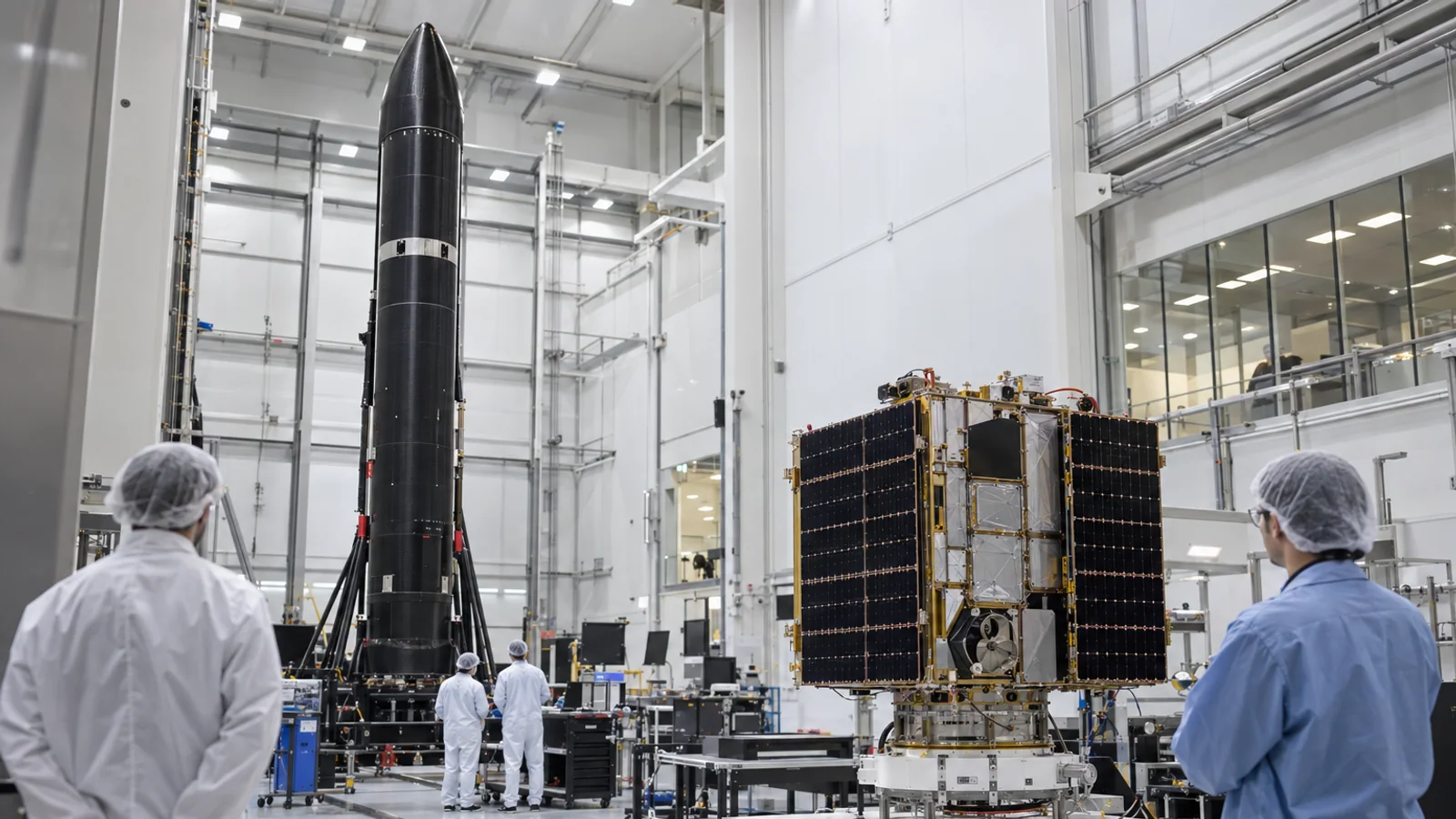
An Electron launch costs about $7.5 million—roughly a tenth of the price of a Falcon 9 mission. It is a much smaller rocket, serving a different market, but it has helped turn Rocket Lab from a New Zealand startup into one of America’s busiest launch companies. Now founder Peter Beck is pursuing something broader: a business that can build satellites, launch them on its own rockets, operate them for customers and eventually sell services from space.
Founded in New Zealand in 2006, Rocket Lab began with an ambition similar to SpaceX’s: make access to space cheaper and more frequent. Its particular opportunity lay in small satellites. The company’s first prototype, the suborbital Atea-1, reached space in November 2009, making Rocket Lab, by its own account, the first private company in the Southern Hemisphere to do so. Atea-1 flew only once. The next step was Electron.
Rocket Lab moved its headquarters to Huntington Beach, California, in 2013 to gain access to US investment, then to Long Beach in 2020. The company’s first 15 launches were supported by a total investment of $180 million. Growth subsequently accelerated: revenue increased sevenfold between 2021 and 2024, reaching a record $602 million in 2025, up 38% year on year. Its order backlog grew by 73%, and its global workforce now exceeds 2,600 people.
Electron remains its flagship. Announced in 2014, it was designed as a low-cost, expendable launcher and has become the second-most frequently launched US orbital rocket on an annual basis, behind Falcon 9. It has completed more than 80 orbital launches in less than a decade, with a success rate of about 95%. At 18 metres tall, compared with Falcon 9’s 70 metres, it is built for a distinctly smaller job.
Its capacity is approximately 300 kilograms to low Earth orbit, or 200 kilograms to a sun-synchronous orbit at an altitude of 500 kilometres. That makes it suitable for CubeSats and other small payloads, at a quoted price of around $25,000 per kilogram. The lower price of an entire launch should not be confused with equivalent carrying capacity: Falcon 9 remains the more competitive launcher overall, a reality that helps explain why Beck has expanded beyond launch services.
Electron uses kerosene and liquid oxygen, the same propellant combination as Falcon 9. Nine Rutherford engines power the first stage, while a single vacuum-optimised Rutherford powers the second. Developed in-house, they were the first engines on an orbital vehicle to use electric pumps. An optional third stage, known as the kick stage, provides additional capability for placing payloads into their intended orbits.
Although Electron was initially designed to be discarded after flight, Rocket Lab has since recovered several boosters. Its approach differs from SpaceX’s powered landings: the small rocket slows through the atmosphere, deploys a parachute and splashes down for recovery by ship. The company also tried catching a descending booster with a helicopter, achieving partial success in 2022 before abandoning the method. Water recovery cost about the same and could be used on more missions. Less spectacular, perhaps, but practical.
The manufacturing changes are just as striking. Electron’s carbon-composite structure initially required about 400 hours of work; robotic manufacturing techniques have brought that down to roughly 12 hours. The company’s stated goal is to produce a complete Electron in seven days. An entire rocket in a week.
Rocket Lab has also adapted Electron into HASTE, the Hypersonic Accelerator Suborbital Test Electron, for hypersonic testing. It is a shrewd extension of an existing vehicle into a market with substantial military demand. In March 2026, the company secured a $190 million contract for 20 HASTE launches over four years, alongside a separate $30 million contract with Anduril.
The other side of the business begins with Photon, a satellite platform derived from Electron’s kick stage. Think of it as a satellite taxi: once in space, it helps deliver payloads to the orbits they need. Photon first flew in August 2020 as a technology demonstrator on the mission I Can’t Believe It’s Not Optical, and later supported the 2022 CAPSTONE mission toward the Moon. It marked a move from simply providing the ride to supplying more of what a mission needs once it gets there.
That expansion now encompasses reaction wheels, star trackers, solar panels, separation systems, propulsion and flight software. Rocket Lab has acquired specialist businesses to bring their expertise in-house, including Mynaric, which produces optical systems for laser communications, and Motive Space Systems, which develops robotics and precision mechanisms for space applications.
The largest step came with the June 2026 announcement of an agreement to acquire satellite-services company Iridium for approximately $8 billion. Both companies have signed the agreement, but completion is expected only in mid-2027, subject to shareholder and regulatory approvals. It is not yet a completed acquisition, but it makes Rocket Lab’s intention to move further into satellite constellations and services unmistakable.
The company is also developing FlatLight, a satellite intended for large constellations, with civil and military applications ranging from communications and navigation to monitoring and remote sensing. Its proposed architecture is scalable and expandable, with reliability and long operating life among its aims. The broader strategy is vertical integration: make the spacecraft, launch it, operate it and ultimately provide the service that the customer wants from space.
That brings the story to Neutron. Still in development, the two-stage, partly reusable rocket is designed to carry up to 13 tonnes into low Earth orbit. At 43 metres tall and seven metres wide at its broadest point, it is considerably larger than Electron, but remains a medium-class launcher with less payload capacity than Falcon 9. It is aimed at a market that includes small satellites and constellations, with the promise of lower launch costs.
Nine Archimedes engines, burning methane and liquid oxygen in an oxygen-rich staged-combustion cycle, will power Neutron’s first stage. The engines have completed full-duration tests of almost five and a half minutes at NASA’s Stennis Space Center, and Rocket Lab says they are ready for flight. Test stands are operating for 20 hours a day, seven days a week.
Neutron’s second stage sits entirely inside a fairing nicknamed Hungry Hippo. Like the first stage, it uses a carbon-composite structure, and it is powered by a single Archimedes engine. The booster is designed to land autonomously on a floating platform in the Atlantic after more demanding missions. With lighter payloads, it should return directly to the launch site.
Rocket Lab announced in 2022 that Neutron would launch from NASA’s Wallops Flight Facility in Virginia. Its inaugural flight is scheduled for late 2026, although the timetable has already slipped. First launches are particularly prone to delays, so an early-2027 debut remains a possibility rather than something to rule out.
The obvious comparison is with Falcon 9, but Neutron’s size, propellants and partial reusability also invite comparisons with Chinese vehicles such as Long March 12A and LandSpace’s Zhuque-3. The field of reusable launchers is broadening, and the gap with SpaceX appears to be narrowing. Whether that lasts is another question: the arrival of orbital Starship flights could widen it again. Rocket Lab’s answer is not simply to build another rocket, but to become a company whose reach extends across the whole space mission.