
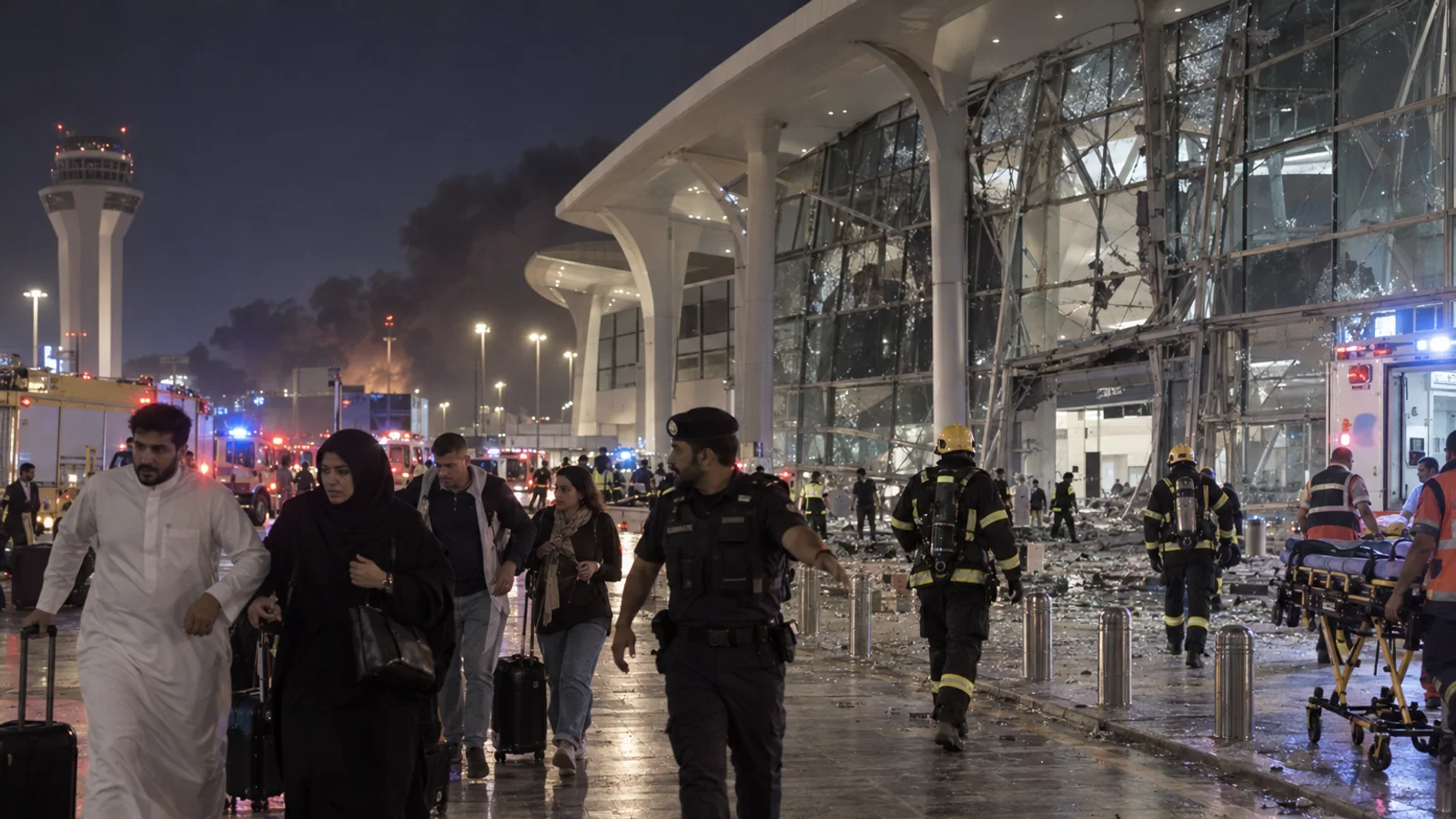
Successive attacks on Riyadh’s King Khalid International Airport have killed passengers and airport workers, prompting Saudi promises of a firm military response and warnings against non-essential travel. Saturday’s missile strike killed 13 people and injured more than 300, making it the deadliest attack on Saudi soil in more than a decade. Saudi officials said another attack on Sunday killed one person and wounded 11.
CCTV footage broadcast by Saudi state television showed a bright orange flash as the missile struck the terminal on Saturday. The passengers visible in the footage managed to get up and escape. Emergency services were reported to have been overwhelmed. Among those killed was Wafaa Al-Waidah, a Syrian mother of four.
The Iran-backed Houthis claimed responsibility for the weekend attacks, as well as an earlier strike on the same airport on Thursday and an attack on an Aramco gas plant. The group said its operations used ballistic and cruise missiles, along with drones. It says it is targeting Saudi Arabia because of the kingdom’s support for government forces in Yemen’s civil war.
The Houthis control large parts of Yemen, where they have fought the internationally recognised government for more than a decade. An uneasy truce over the past couple of years has broken down. Rapid Houthi advances along the coast last month enabled the group to threaten Saudi shipping in the Red Sea. Saudi Arabia responded with air strikes, followed by further Houthi attacks.
BBC Monitoring’s Hesham Shawish said Saudi military statements had described the weekend attacks as war crimes and promised to respond firmly and decisively. He reported Saudi coalition and Yemeni army strikes on Houthi-held territory, including Sana’a, Taiz in the southwest and Saada province along the northern border. He expected a stronger Saudi response than on previous occasions.
The British Embassy in Saudi Arabia advised British citizens to cancel all but essential travel to Jeddah, Dammam and all airports in the kingdom except Medina.
The Houthis also issued a warning to airlines to avoid Saudi airports and airspace, excluding the areas of Mecca and Medina. Shawish said the warning signalled that civilian aviation infrastructure had become part of a pressure campaign intended to make Saudi Arabia lift its blockade on Houthi-held territory. Its purpose, he said, extended beyond physical destruction to amplifying the psychological and economic impact of the attacks.
President Trump condemned the Riyadh airport attack without committing to military involvement. “Look, the Saudis are good fighters, but I think the attack was a terrible thing,” he said.
Saudi media were closely scrutinising Trump’s remarks and watching for Washington’s next move, Shawish said, alongside reporting international messages of solidarity. In his assessment, the absence of a comprehensive defence pact with the United States was emboldening the Houthis to target the kingdom’s civilian aviation infrastructure.
Shawish said the recently signed MECA defence pact between Saudi Arabia, Pakistan and Turkey would also face a test. Whether Pakistan or Turkey would provide advanced weapons or troops remained to be seen: so far, he said, their support had consisted of strong statements rather than material assistance.
Speaking from Riyadh, geopolitical analyst Salman Al Ansari argued that the airport attacks fitted a wider pattern of Iranian threats against civilian aviation. He cited a September 23 warning by Mohsen Rezaei that airports in neighbouring countries could be disrupted if those countries helped halt Iranian flights.
Al Ansari also pointed to what he described as significant advances by Yemeni government forces around Bab al-Mandab. He claimed Iran had tasked the Houthis with controlling the strait to strengthen Tehran’s hand in negotiations with the United States, but that government gains had thwarted that strategy. Despite the Houthis’ ability to launch attacks, he argued, the group was losing ground.
His proposed response was an extensive military escalation. “A decisive, all-out confrontation is needed,” he said, arguing that political dialogue and appeasement were no longer viable. He called for the Houthis to be treated as a terrorist organisation like ISIS and al-Qaeda.
Pressed on what that would mean in practice, Al Ansari advocated operations on land, at sea and in the air. He acknowledged the danger to civilians: by his account, the Saudi-led coalition had secured 80% of Yemen’s territory, but 80% of the population lived in the remaining area.
Al Ansari maintained that defeating the Houthis was necessary, while saying Saudi Arabia and its partners were seeking a way to do so with the fewest possible casualties in Yemen. His call for an all-out confrontation underscored the prospect of a much wider campaign following the airport attacks.