
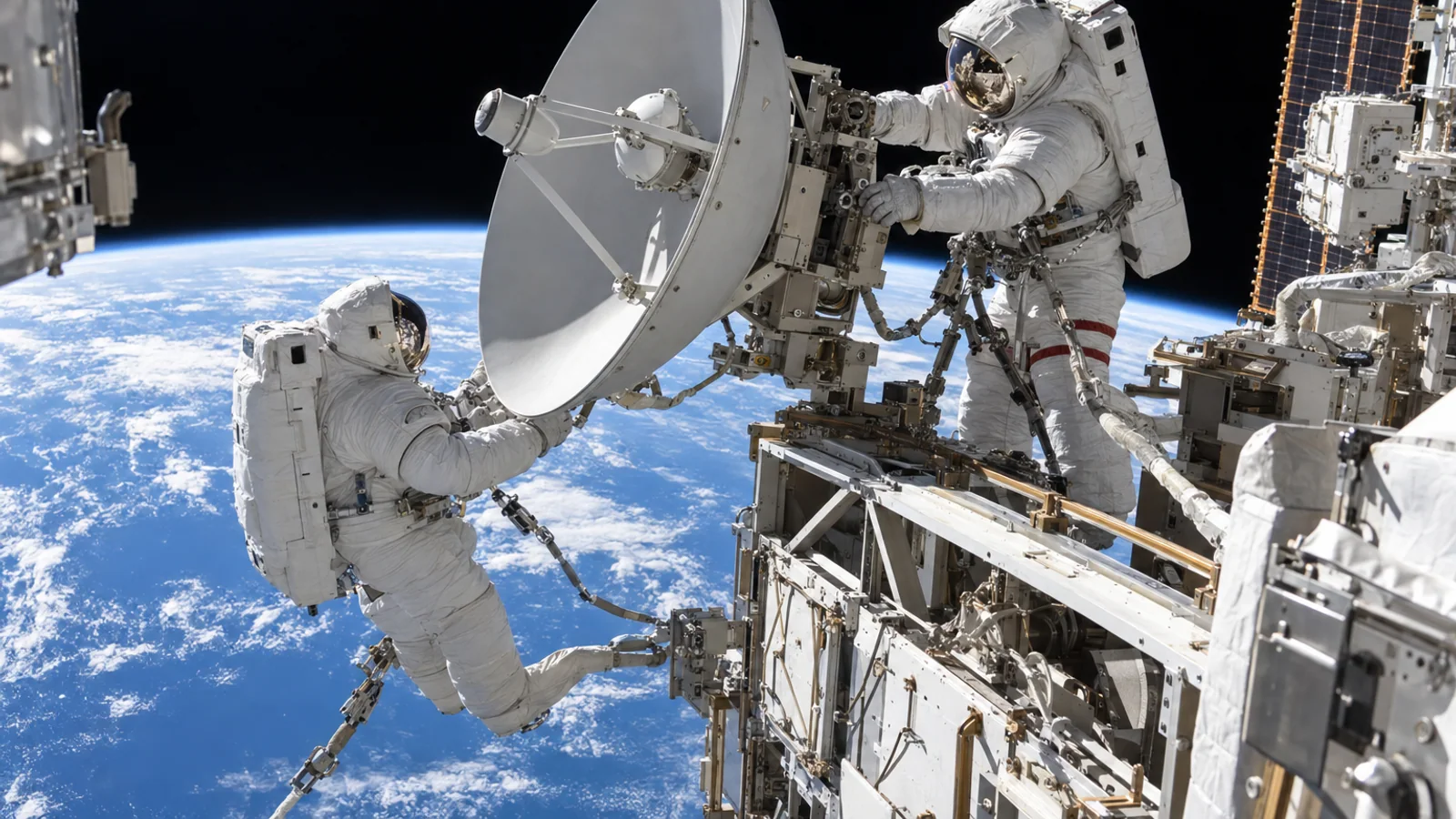
After six months aboard the International Space Station, ESA astronaut Sophie Adenot received the assignment she had spent years preparing for: her first spacewalk. On August 18, she stepped outside alongside NASA astronaut Anne McClain, becoming the first French woman and the second European woman to perform an . By September 1, she would have completed three spacewalks, spending a total of 19 hours and 42 minutes outside the station.
The first outing, US EVA 97, had one main objective: remove and replace one of the station’s two . These enable high-rate Ku-band communications between the ISS and Earth through Tracking and Data Relay Satellites. Since November 2025, a failed gimbal had prevented one antenna from pointing towards those satellites.
Replacing it was a substantial handling task. The failed antenna had a mass of 88 kilograms, with a dish 1.8 metres across, mounted on a boom on the station’s Z1 truss. McClain reached the worksite riding the , operated from inside the ISS by NASA astronaut Jack Hathaway, while Adenot moved independently across the station’s exterior.
Outside, temperatures can range from around minus 157 to plus 121 degrees Celsius, depending on sunlight and shadow. Spacesuits must protect astronauts from those extremes while functioning as miniature spacecraft. The hardware, meanwhile, has endured years of heating, cooling, expansion and contraction. As Adenot and McClain secured the antenna and worked to disconnect its electrical connectors and mounting bolts, several proved stubbornly stuck.
Freeing the antenna took extra time and close coordination with Mission Control. With the clock running down, the team revised the plan. Rather than move the old antenna to its storage platform and install the replacement, the astronauts secured it to the station structure. They returned inside after six and a half hours, with the replacement still to be completed.
A week later, Adenot and McClain went back out. They retrieved the spare antenna, transported it into position and prepared the mounting point. Adenot cleaned and lubricated the bolt inserts to help ensure the new hardware could be properly secured. This time, the work succeeded: the team on Earth confirmed that the newly installed antenna had good power and data connections.
After almost 13 hours outside across her first two EVAs, Adenot was assigned a third, this time as EV1, leading the spacewalk work. On September 1, she joined NASA astronaut Jessica Meir to replace a spacecraft-navigation retroreflector, prepare the for future maintenance, replace an external camera and collect an exterior swab to look for microorganisms.
Again, the astronauts had to adapt. Adenot experienced an unusual restriction in her left arm, making it difficult to move her shoulder. Mission Control guided her through a series of movements to assess the problem and confirm that she could still carry out the necessary rescue procedures if needed.
Before re-entry, the crew traced the restriction to a cable from the around Adenot’s shoulder. Once it was freed, she confirmed that her full range of movement had returned. As a precaution, Mission Control adjusted the airlock entry procedure: Adenot went in first, and Meir closed the hatch.
The three spacewalks brought technical skill, contingency planning and teamwork into sharp focus. The first required patience with uncooperative hardware; the second built on that experience to finish the replacement; the third demanded a careful response to a spacesuit problem. Throughout, astronauts inside the station and teams on the ground helped assess difficulties and work through solutions.
For Adenot, the experience also deepened the human side of a long-held ambition. “I wanted to become an astronaut to explore space,” she said, describing how much she had come to value a professional, mission-focused team that “gives me good vibes every time I hear their voice”. She felt more connected to the people she worked with, while the beauty of Earth strengthened her desire to care for the home planet.