

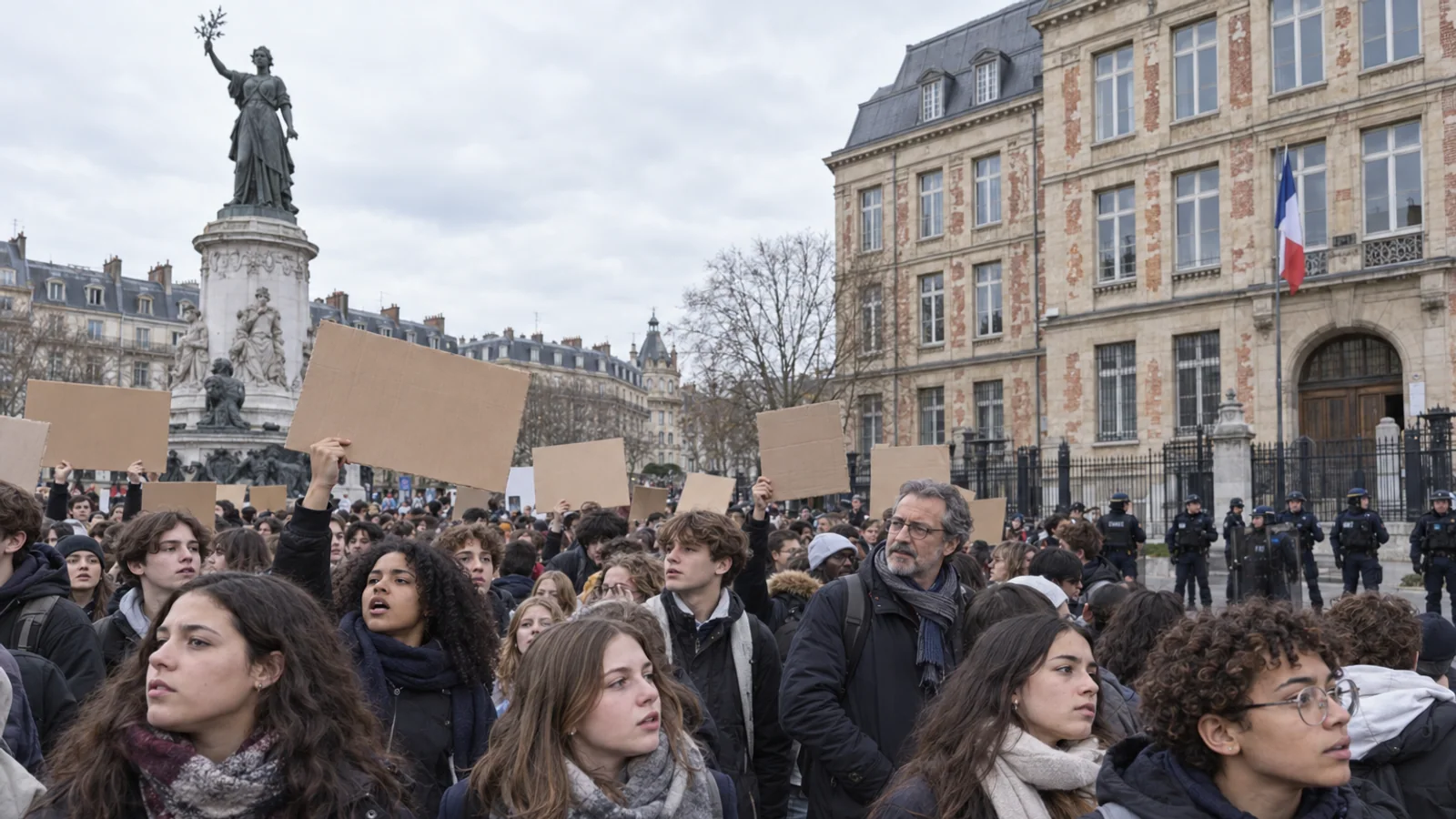
Students across France have taken part in a demanding better learning conditions and greater equality in education, as a protest movement that began in the Parisian suburbs entered its third week. Pupils say they are prepared to return to the streets if their demands go unanswered.
At Place de la République in central Lille, thousands gathered with placards and banners, many of them teenagers who would ordinarily have been in school. Their complaints range from to buildings that are too hot in summer and too cold in winter. Long teacher absences can leave students without lessons for weeks. Hugo, a private school student, described the movement as “a global fight for the youth”, seeking both better education and equal chances to access it.
For some protesters, the state of school buildings is the most immediate concern: leaking ceilings, rats, flooding and years of decay. Joanna, now a university student, attended high school in the Parisian suburbs, where the movement began amid longstanding demands for greater equality in some of France’s most deprived communities. She described learning conditions as “terrible, terrible”, and said the demands extended beyond high schools to younger pupils.
Joanna spoke of roofs falling onto students, floods inside buildings and infestations. Some schools dated from the 1970s and had not been renovated, she said, while toxic substances remained a concern in buildings, particularly in the suburbs. Alongside these complaints, students are challenging the system governing , which they say is discriminatory and favours those from wealthier backgrounds.
. Eric Loiseau, a high school teacher in Marseille, said his union and most other teaching unions opposed the government’s proposed budget. Teachers had been on strike the previous week and were continuing to support pupils. He described conditions as having deteriorated nationally over the past 20 to 25 years, estimating that the average school building was about 60 years old. His own school opened in the 1860s.
For Loiseau, prolonged gaps in teaching are a direct consequence of budget cuts. He recalled working in a pool of substitute teachers around 20 years ago, a provision he said had since been curtailed because of insufficient funding. “So when someone is away, there is no substitute. It’s very simple.” Those absences, he added, could last for weeks.
But the conditions inside schools have increasingly shared attention with violence outside them. Over the course of the unrest, and about 24 schools burned and ransacked. Dozens of teaching staff had been injured, along with students, some seriously. Police have faced accusations of responding with excessive force.
In Lens, northern France, a 15-year-old boy lost a hand in an incident involving a police grenade. Police said he had picked it up; some protesters claimed officers had fired a grenade towards his hand. An inquiry is underway. The boy remained in hospital, but his life was not in danger.
The competing accounts reflect a wider dispute over responsibility for the escalation. One protester argued that many demonstrators were peaceful and that aggressive policing was provoking violence in response. The protester also drew a distinction between students damaging objects and injuring people.
In Lille, firefighters extinguished a bin set alight outside a school. Later, after a largely peaceful day of demonstrations, riot police fired tear gas to disperse a crowd. A group had begun trying to erect barricades using street barriers and bins before officers moved in. Police were stationed at several points around the city in anticipation of further trouble.
The movement, described as France’s largest student protests in many years, comes six months before a presidential election in a deeply divided political climate, with the far right close to power and the far left performing well in opinion polls. Whether the protests will expand or dissipate remains uncertain. So far, government measures do not appear to have quelled the anger, and pupils insist that the conditions in which they learn must change.