
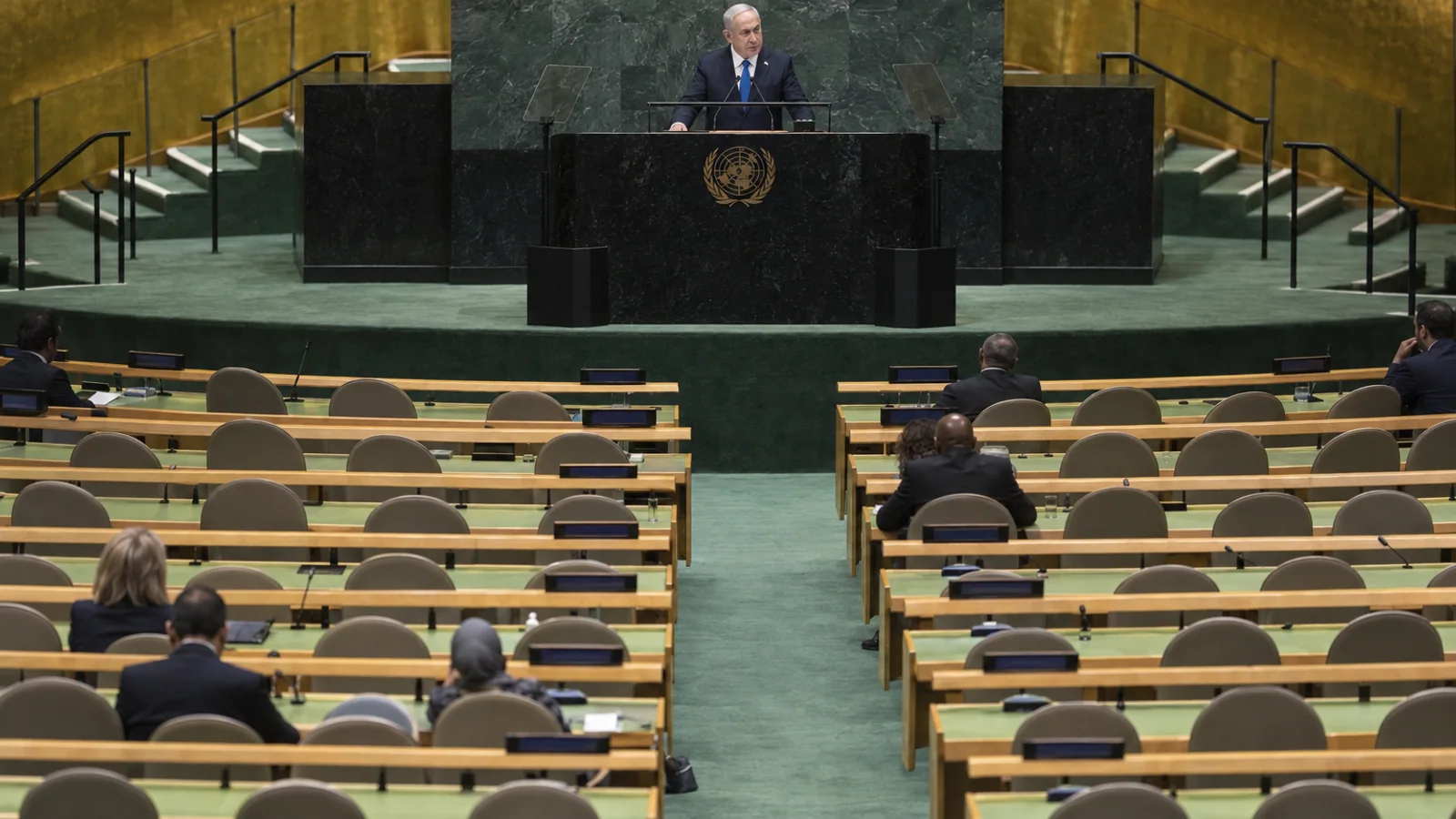
“If there are any other moral cowards who still haven’t left this room, please do so now.” Benjamin Netanyahu opened his address to the United Nations General Assembly with a direct attack. As the Israeli prime minister took the floor amid jeers, hundreds of delegates from countries around the world left the chamber in protest, while the session’s president called for order.
Outside UN headquarters, protesters had also gathered in the streets of New York. Police arrested around 100 people. Inside and outside the assembly, the confrontation centred on Gaza, where bombardment and famine have devastated the population.
Following Hamas’s October 7 attack, in which 1,200 people were killed and 250 taken hostage, nearly 74,000 Palestinians have been killed in Gaza and entire neighbourhoods razed. Netanyahu arrived at the UN subject to an International Criminal Court arrest warrant for war crimes and crimes against humanity, with allegations including the use of starvation as a weapon of war and attacks directed at civilians.
From the podium, he rejected the accusations outright. He called the allegation of genocide “the biggest lie of the century” and dismissed settler violence in the West Bank as the actions of “just 150 delinquent kids throwing stones.”
He also accused longstanding allies, including France and the United Kingdom, of hypocrisy. “They accuse us of colonialism, but they invented the term colonialism,” he said. Turning to New York’s mayor, he called him antisemitic and shouted: “You can’t silence me.”
Netanyahu then waved a Starlink antenna, saying he would give it to the Iranian delegates when they defected. His point was that only then would they be able to speak freely, without submitting to the regime.
Why adopt such fierce and provocative language in a global diplomatic forum? Many analysts see the intended audience not as the international delegations sitting before him, but as Israel itself. With elections scheduled for October 27, Netanyahu faces intense pressure at home: criticism of his handling of security, as well as a disadvantage in the polls.
In that reading, the UN address was closer to a campaign speech than an attempt at diplomatic persuasion—a display of strength designed to present Israelis with the image of a leader ready to stand alone against the entire world.