
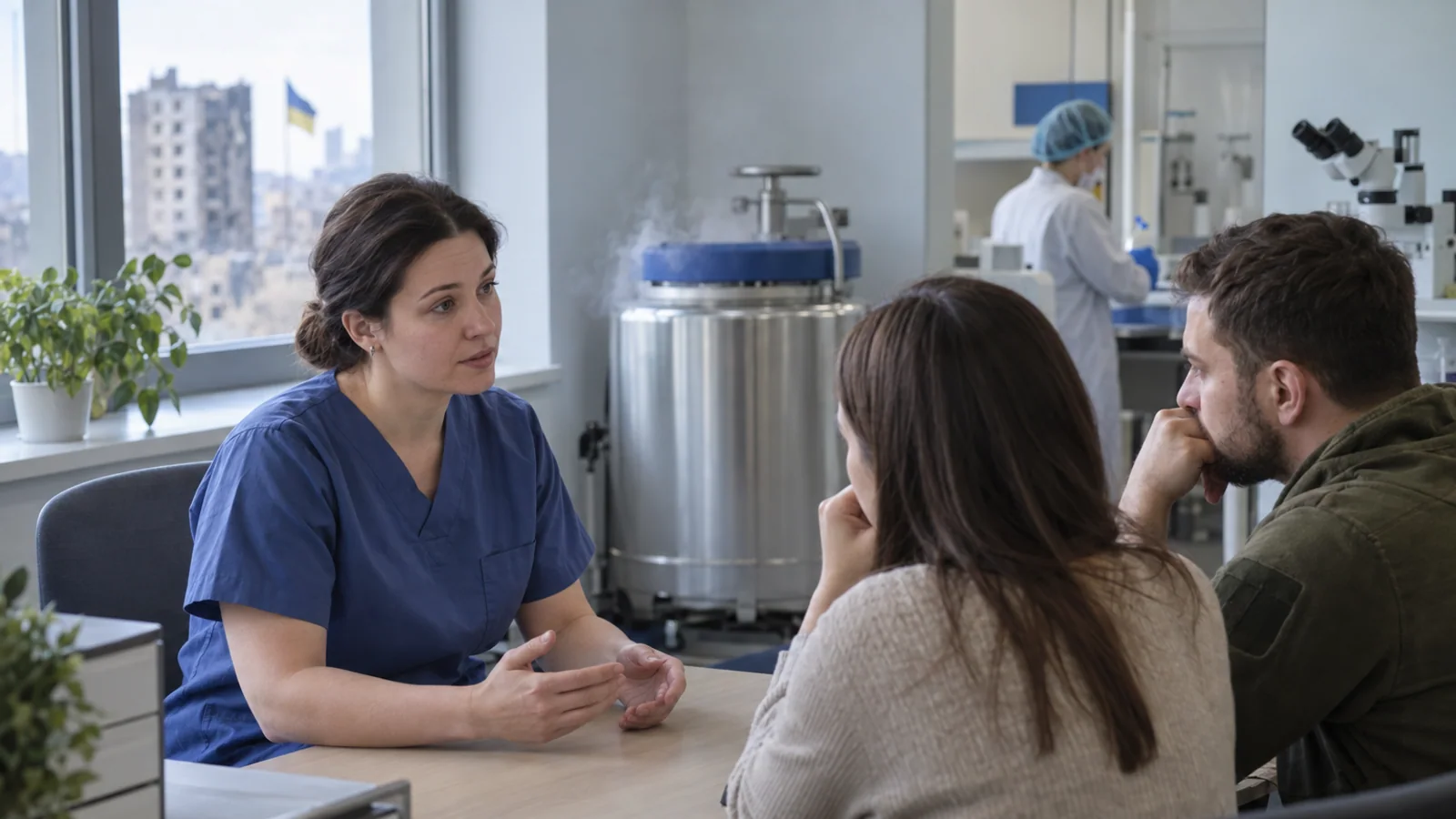
Ukraine has one of the lowest fertility rates in the world, estimated at around . The figure is approximate: migration and the occupation of territory make precise calculations difficult. Birth rates were already declining before the war, as in many Western countries, but since 2022 the fall has been sharp and sustained.
The government in Kyiv has responded with measures intended both to protect those directly involved in the conflict and to offer broader support to people hoping to become parents. Since 2024, the state has funded . A further measure, introduced in 2025, provides for military personnel and other eligible workers, including police officers, whose fertility may be threatened by war injuries. If they lose the ability to conceive naturally, stored reproductive material can preserve the possibility of parenthood through publicly funded fertility treatment.
Work on the legislation protecting military personnel began in 2023. But one question required months of political debate: what should happen to the stored material if the service member dies? Ukrainian law now allows the eggs or sperm of someone killed during the conflict to remain frozen at state expense for up to three years. After that, the family must pay for continued storage.
The provisions allow a woman to have a child using the stored sperm of a husband or partner who has died in the war. This requires a signed document in which the person whose reproductive material is being stored . Preserving the possibility of parenthood therefore also means addressing the wishes of someone who will no longer be there to confirm them.
Ukraine is not alone in facing that question. The United Kingdom, the United States and Israel offer different approaches to posthumous reproduction. In the UK, strict protocols allow material to be stored for up to ten years after a person’s death, but documentation must establish that they wanted their eggs or sperm to be used in those circumstances. The United States has no federal law governing the practice, leaving a patchwork of rules that differ from state to state.
Israel has given the issue particular attention, in part because of the population’s broad involvement in military service. Even before 7 October 2023, sperm could be retrieved from a deceased soldier. The procedure has a narrow window: to be effective, retrieval must take place .
Following 7 October, Israel introduced rules allowing sperm to be retrieved promptly from a young soldier killed in war and frozen at the request of a partner, wife or parents, without first obtaining a judge’s approval. Retrieval can proceed even without a specific written declaration from the deceased. The immediate decision to preserve the sperm is thus separated from the later legal question of whether it may be used.
At that later stage, the identity of the person making the request matters. If it is the deceased man’s partner or wife, a shared wish to have a child is generally presumed. If his parents seek to use the stored sperm, they must demonstrate that he wanted to conceive a child.
Technology makes these possibilities available; it does not resolve the ethical doubts behind them. The wishes of the person who has died remain central, alongside questions of parenthood and inheritance. There is also the question of how long such rights should be protected, and who should be entitled to exercise them.