

U.S. President Donald Trump said Russia and Ukraine had agreed to an immediate ceasefire on attacks against energy infrastructure, but Kyiv’s response left open fundamental questions about what had been agreed and whether it was taking effect. The announcement followed a turbulent weekend in which Trump called for President Volodymyr Zelensky’s replacement and faced criticism over a deal easing sanctions on Russian diesel exports.
“Effective immediately, there is an in the war between Russia and Ukraine. Both parties have agreed. Do not break it,” Trump wrote on Truth Social. Zelensky welcomed the prospect without confirming that a settled agreement was already in place. “It is important that this becomes a reality,” he said, adding that Ukraine was prepared to stop striking Russia’s energy sector and was counting on a similar willingness from Moscow.
Euronews Ukraine correspondent Sasha Vakulina said it remained unclear whether the announcement reflected an agreement reached with both governments or a unilateral declaration by Trump. She recalled an earlier energy ceasefire announcement in September that never materialized. Ukraine has advocated such a pause for months as Russian attacks damage its power infrastructure; some Kyiv neighborhoods had recently spent more than 20 hours without electricity.
The terms matter as much as the announcement. Vakulina raised questions about reports of a , warning that Ukraine has only one large refinery, already damaged by Russia. Ukrainian strikes on Russian refineries aim to reduce the revenues available to sustain Moscow’s war, she said, while Russia has been attacking Ukraine’s civilian energy infrastructure. A narrowly drawn agreement would therefore leave important questions about what was actually protected.
Trump’s renewed criticism of Zelensky sharpened those doubts. A day before announcing the truce, he accused Kyiv rather than Moscow of obstructing peace and called for a Ukrainian leader who could make a deal. His agreement with Vladimir Putin to ease restrictions on Russian diesel exports had already drawn sharp criticism from Ukraine and Europe.
Vakulina argued that Washington had less leverage over Kyiv than before, although it retained consequential options: withholding intelligence, disrupting access to or restricting weapons sales to European countries buying arms for Ukraine. She considered the last option less likely because those sales bring billions of dollars to the United States. Zelensky, meanwhile, has said he is ready to organize elections if there is a ceasefire lasting at least 60 days. Trump made no corresponding demand for elections or a leadership change in Russia.
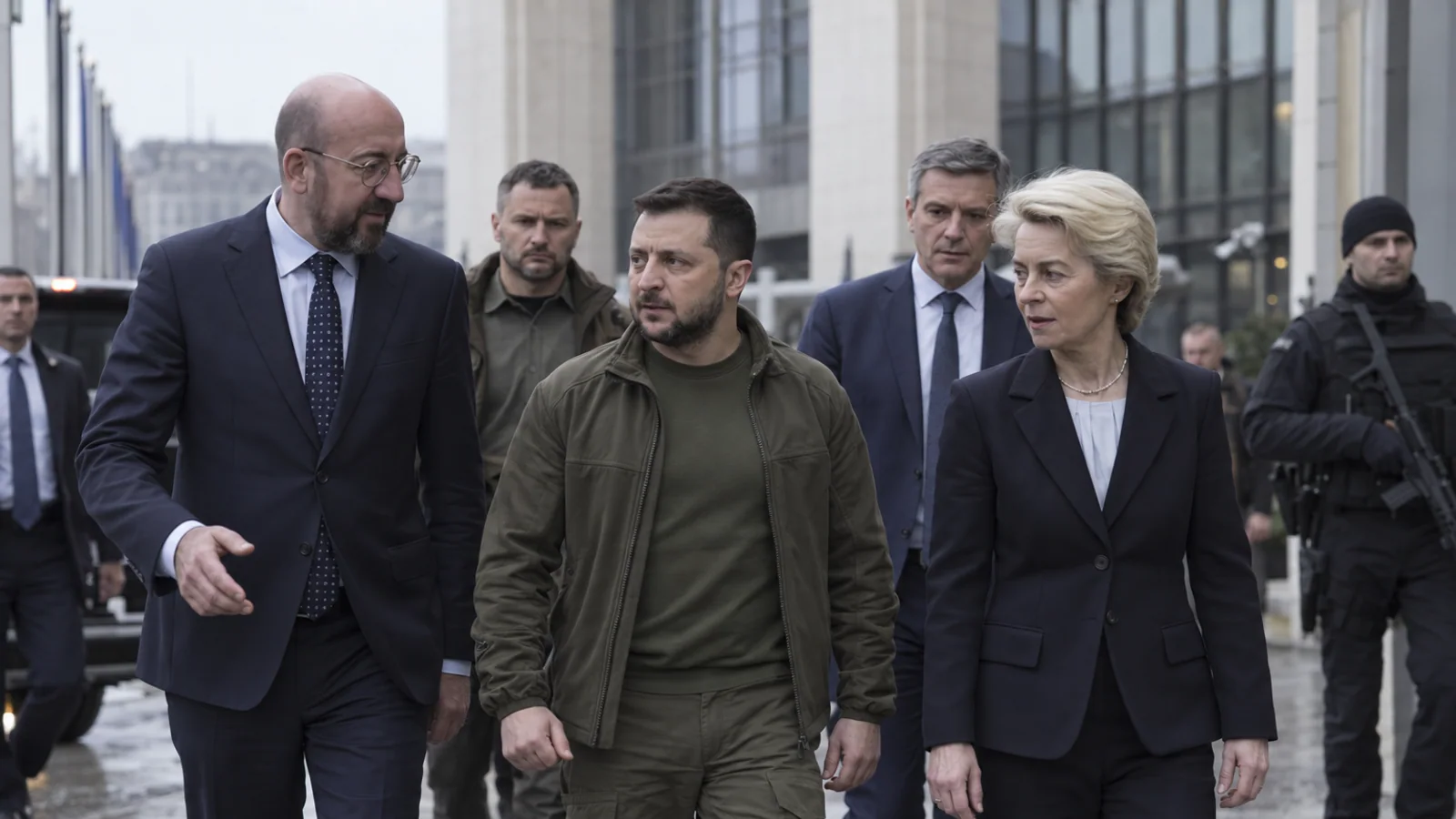
Europe’s response was one of support for Zelensky. Following a call with the Ukrainian president on Sunday, backed an energy ceasefire if it spared Ukrainian infrastructure from Russian attacks and reaffirmed her support for his leadership. Zelensky was due to address the Warsaw Security Forum as he sought closer coordination with European allies.
Ukraine will also be central to Thursday’s European summit, where Zelensky is expected in person in Brussels. Financing, including money for drones and missiles, is on the agenda. But the funding question remains difficult: European countries are providing the bulk of financial support and paying for U.S. weapons for Ukraine. Von der Leyen said the EU would seek a wider global funding effort, with winter still ahead.
Along NATO’s eastern flank, concern over drones, airspace violations and sabotage formed part of the backdrop to an EU foreign ministers’ meeting in Luxembourg. Latvia’s Foreign Minister Baiba Braže said the overall military assessment had not significantly changed: Russia remained tied down in Ukraine and lacked the capabilities to challenge NATO militarily.
That did not mean the threat was absent. Braže rejected “hybrid” as too mild a description of activities ranging from sabotage and threats against defense industry executives to cyberattacks and disinformation. She also described organized pressure on Latvia’s border from Belarus, enabled by Russia, with groups attempting to cross, tunnels being dug and border cameras stolen.
Asked whether was sufficiently protected, Braže answered yes. She pointed to forces from 14 allies serving alongside Latvia’s own military, with capabilities on land, at sea and in the air. “NATO’s KPI is peace,” she said, presenting deterrence—not confrontation—as the alliance’s purpose.
In Saudi Arabia, a second consecutive day of attacks on Riyadh’s King Khalid International Airport deepened a separate security crisis. A strike on Saturday killed at least 12 people and injured more than 300. On Sunday, another projectile hit passenger terminals, causing a fire and further injuries. Airport operations were fully suspended.
The Houthi rebels claimed responsibility and warned airlines and passengers to stay away from Saudi airports. Saudi Arabia vowed a firm response, while the United Nations and European Union condemned the attack. The Houthis also accused the Saudi-led coalition of killing civilians in recent strikes on the airport in Sana’a.
Washington was weighing whether to join the military campaign against the Houthis in Yemen. Trump condemned the airport attacks, although Euronews correspondent Laila Humaira reported that he had ruled out new military action before the November 3 midterm elections. The attacks on Saudi energy, civilian and aviation infrastructure raised the prospect of a wider and more prolonged confrontation.
Iran’s test-firing of multiple ballistic missiles added to those concerns. The United States was reassessing and repositioning military assets in the region, including bombers, refueling aircraft and aircraft carriers, while Iranian officials signaled that they were preparing for a prolonged conflict rather than responding to rhetoric from Washington.
France, meanwhile, faced a different balancing act: thousands of students were demanding more resources and better conditions as the government struggled to repair public finances. With the deficit around 5% of GDP and public debt approaching 120%, there was little room to answer those demands through additional spending.
Economist and essayist Nicolas Bouzou said France was “at the end of a system” in which economic growth was no longer strong enough to sustain its large welfare state. He warned that long-term interest rates approaching 5% would be unsustainable for an economy in France’s position, adding further pressure to its rising debt.
For Bouzou, the problem was not simply the stock of debt. Persistent deficits and political uncertainty were undermining confidence, with a government lacking a parliamentary majority and a presidential election ahead. He said both the far right and far left could win, while neither had sufficiently precise proposals for addressing the debt challenge.
Yet he resisted the conclusion that a broader economic decline was inevitable. France retained important strengths, including its electricity sector and strong companies. Its central weakness, he argued, was public finance—and that was a problem that could be solved. “If we solve that, France will be okay.”