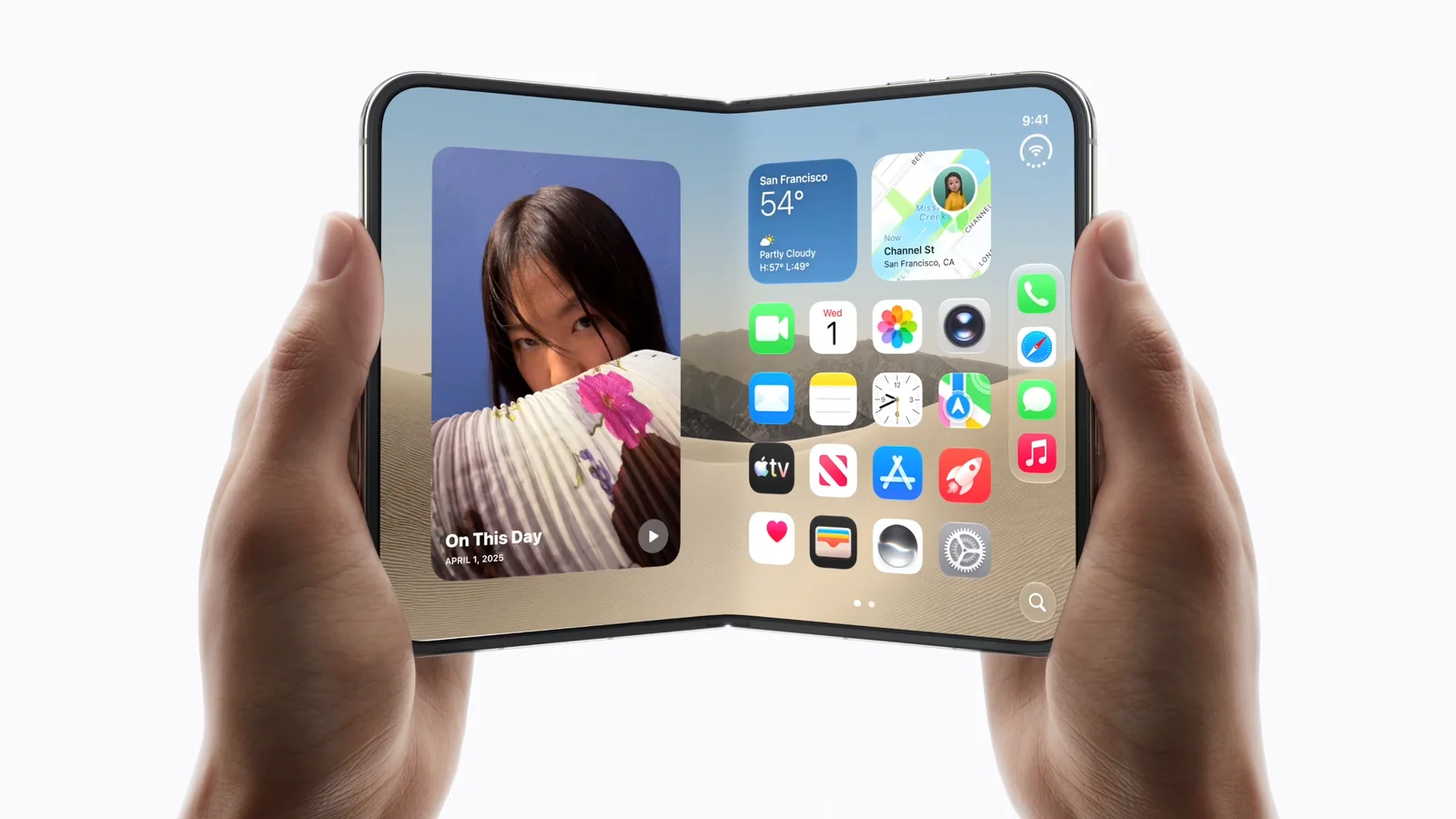
The foldable was easily the star of Apple’s latest September event, which also marked the beginning of a new chapter for the company. John Ternus led the presentation, opening with a symbolic farewell to Tim Cook. One era appears to be ending, while another is just getting started.
Apple unveiled the iPhone 18 Pro and Pro Max, new AirPods, the Apple Watch Series 12 and Apple Watch Ultra 4, but no standard iPhone 18. That absence is interesting and may reflect the growing pressure on global chip production. AI companies and data centres are consuming an enormous share of manufacturing capacity, making processors, memory and graphics hardware more expensive for everyone else. Even Apple may be struggling to secure enough chips for its entire product line.
As for Apple Intelligence, there were plenty of announcements but few genuine surprises compared with WWDC. European users have an additional reason to temper their enthusiasm: many of these features may not reach Italy anytime soon because of regulatory restrictions.
The iPhone 18 Pro and Pro Max look very similar to their predecessors. The colours include black, white, a pale “glacier” blue and a rather attractive burgundy. The Dynamic Island is apparently smaller, although you may need to stare at it for several seconds before noticing.
Inside, however, Apple has introduced the A20 Pro, its first chip manufactured using a two-nanometre process. Smaller transistors should provide more performance in less space, while a redesigned cooling system and improved efficiency are expected to help battery life.
Apple remains wonderfully mysterious whenever batteries are involved. Instead of simply telling us their capacity, the company prefers to talk about hours of video playback and carefully selected usage scenarios. So yes, the battery should be better, but we will have to test it before understanding how much better.
The genuinely interesting upgrade is the main 48-megapixel camera. It now includes a physical variable aperture, similar to what you find in professional camera lenses. Small mechanical blades open and close to control how much light reaches the sensor.
In darker conditions, the aperture can open to capture more light. Under bright sunlight, it can close down. It should also give creators more control over background blur, which could be especially useful for video. The system appears to offer four fixed settings, ranging from approximately f/1.4 to f/4.
Apple has also expanded the native professional camera controls, allowing users to adjust aperture, white balance and other parameters without relying entirely on third-party apps.
A quieter but potentially much more important feature is Apple Reference Image. The system is designed to certify that a photograph represents something genuinely captured by the camera rather than an image created or heavily altered by AI. Authentication begins with the sensor’s original pixels and is processed cryptographically on the device.
Today, this might sound like a solution looking for a problem. But in a world increasingly filled with convincing AI-generated photographs, having a verifiable certificate of authenticity could become extremely valuable. It may ultimately prove more significant than another camera lens or a slightly smaller Dynamic Island.
Prices remain predictably painful. The iPhone 18 Pro Max starts at €1,639 and rises to around €3,139 in its most expensive configuration. In the United States, Apple is also introducing a subscription-style option: customers can pay $34.99 per month for 24 months to use the latest iPhone without ever truly owning it. That opens an entirely separate, and rather enormous, conversation about the future of ownership.
The new AirPods 5 receive modest improvements, including a version with a wireless-charging case and controls directly on the earbuds. The Apple Watch Series 12 and Ultra 4 also look nearly identical to the previous models, but include an improved heart-rate sensor capable of taking measurements approximately every five seconds.
Apple is clearly moving beyond simple fitness tracking and towards a more complete view of personal health. This is already familiar territory for products from Garmin, Fitbit and other wearable companies, but Apple’s enormous ecosystem gives it a unique advantage.
The watches may also use on-device AI to understand the context of your day and create summaries of lectures, presentations or even conversations. Other apps and dedicated devices already offer similar functions, but Apple claims its version will be heavily encrypted, processed locally and designed without saving or uploading the original audio.
That privacy-first approach could make the feature genuinely useful. A device already sitting on your wrist all day is the natural place for this kind of personal assistant. The trade-off is that local processing may produce weaker results than more powerful cloud-based systems. Still, the combination of AI and privacy is one of the areas where Apple may have something genuinely distinctive to offer.
And then we arrive at the main attraction: the iPhone 2.
The name is a little strange. “iPhone Ultra” had already been widely suggested, while “iPhone 2” creates the obvious question of what Apple intends to call the second generation. The iPhone 2 2? We will deal with that particular disaster next year.
Its design would have felt revolutionary twelve months ago. Today, it looks remarkably similar to the latest foldables from Samsung, Oppo, Xiaomi and Huawei. Apple may have influenced some of those designs through early leaks and supply-chain information, but the unavoidable reality is that it has entered the foldable market years after everyone else.
When closed, the device is roughly the size and shape of a passport, with a 5.4-inch external screen. Open it and you get a 7.6-inch internal display. This elongated format makes far more sense than foldables that become almost square, because videos and apps can actually use the additional space.
The phone has two rear cameras: a standard main camera and an ultrawide. The external screen uses a conventional punch-hole selfie camera, while the internal camera sits underneath the display. Samsung experimented with similar technology, with mixed results, so it will be interesting to see whether Apple has managed to make the camera genuinely invisible.
The same applies to the crease. Apple uses an extremely elaborate hinge involving titanium, carbon components and multiple layers of glass and protective materials. The company carefully suggests that the crease will be less visible than on rival devices—not that it will disappear. In other words, yes, you will still see it.
Apple’s real advantage may be the software. Rather than simply stretching the normal version of iOS across a larger screen, the company has redesigned menus, controls, animations and multitasking around the folding hardware. The phone understands the angle at which it is positioned and can adapt accordingly, turning part of the display into a keyboard, a stand, an alarm-clock interface or a multitasking surface.
None of this is completely new. Samsung remains the reference point for foldables and has spent years refining similar ideas. But hardware–software integration has always been one of Apple’s greatest strengths. Tiny animations and apparently trivial interface details often create that elusive feeling that a product belongs to the future.
Battery life remains the biggest uncertainty. Apple has divided the battery between the device’s two halves and hidden many components inside the camera plateau to keep the body thin. It is clever engineering, but thinness and foldable displays are not usually the ideal recipe for extraordinary endurance.
The iPhone 2 supports the USB-C Apple Pencil and carries an IP68 water- and dust-resistance rating. It uses Touch ID in the side button instead of Face ID, supports eSIM only and appears to offer some form of MagSafe compatibility—although Apple was strangely vague about whether the magnets are built into the phone or require a dedicated case.
The foldable will apparently arrive in Italy, with pre-orders beginning on 16 October and availability from 23 October. It comes in Starlight White and Night Sky, a very dark blue, with a titanium frame.
Then there is the price. The base model starts at €2,369, which is already an absurd amount of money. The two-terabyte version reaches €3,869, making it the most expensive iPhone Apple has ever produced.
Of course, Apple has long sold more than hardware. It sells design, fashion, status and an ecosystem that makes leaving increasingly inconvenient. But even by Apple’s standards, nearly four thousand euros for a phone is a spectacular number.
Without the iPhone 2, this might have been one of Apple’s quietest events ever. There were no camera-equipped AirPods, no glasses and none of the stranger products suggested by recent rumours. We may see more announcements over the coming months or next spring.
Technology is currently in a peculiar position. Artificial intelligence is advancing at extraordinary speed, while mature products such as smartphones are already so polished that meaningful annual improvements are increasingly difficult to find.
The iPhone 2 does not reinvent the foldable phone. Samsung and others arrived first and have already solved many of the obvious problems. What Apple may do, however, is take an existing category, refine the experience and finally make it feel coherent to millions of people who previously had no interest in it.
Whether that experience is worth €2,369, let alone €3,869, is another question entirely.